The net readings are always taken after the charge has finished and the battery in idle mode
1 Like
Intrigued by this story as we are also with EoN and considering replacing our FIT system; and was wondering how you got EoN to agree to an increase in the inverter size as well as increasing the size of the array which will surely increase your earnings, am I understanding this correctly?
On the meter issue, I assume you used to have a separate FIT meter that you read each quarter and reported to EoN who then paid you for the kWh generated. We’ve just had our old black meter changed for a smart meter so we can use Octopus Intelligent Go and that has two registers, consumed and generated. In one of our properties we had a tenant arrange a meter change without us knowing about it and that just had one register which apparently could run in reverse, but it wasn’t smart. We’ve been told by Octopus that when we get out export MPAN they’ll use the export register for payments, but only if we move from deemed export on our FiT to their export. Probably not very helpful to you, but just out experience.
1 Like
What did your installer say? Will they come and double check the meter is wired correctly?
1 Like
I’ve asked for them to visit but due to illness their technical director has had to step in to help out at the coal face, he hopes to come sometime towards the end of next week.
Do you think thats the problem?
1 Like
Do you have a wireing configuration you could share with me so when he comes i can check his observations
1 Like
Can you suggest a good set up for the inverter with this system?
At the moment my setings are, eco on and a forced charge from the grid between the hours of midnight to 7.00 am. The battery starts to charge at midnight until full then the system or battery goes into idle mode untill 7.00 am (the grid services the house in this period) and then kicks in to service the house.
The idea being the system does not draw on the battery for 7 hours, effectively giving the battery more capacity because it only has to service the house for 17 hours not 24
1 Like
Do you think it would be a good strategy to do a forced discharge so that the battery is at or near zero just prior to charging.
1 Like
Actually thinking about the last point a bit more all that would do is discharge any latent pv energy stored in the battery into the grid.
1 Like
Not sure. But it could be a good guess.
1 Like
I assume you get cheap power overnight, if not, there’s no point charging from the grid as it wastes money.
Equally force exporting is only worth it if you have measured export (e.g. SEG or FIT that isn’t deemed).
1 Like
Yes charge from the grid because its 7 p per kwh
2 Likes
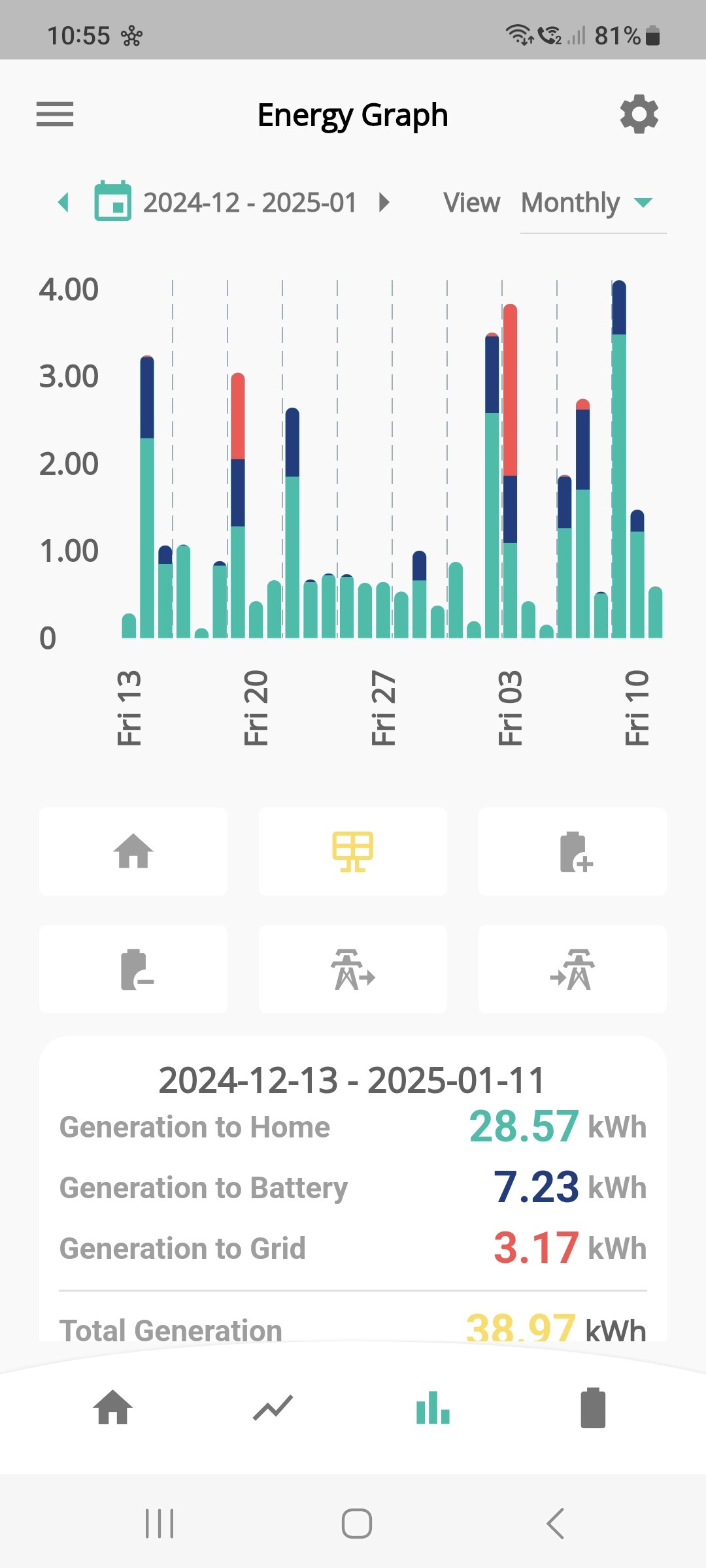
So you can see from my pv generation profile over the last month and it is clear if you deduct the kwhs that went to the battery and grid export from the home consumption figure the sum equals or is damn near the net meter reading of 18.4 kwhs .
1 Like
Bit of an update to this old post. It’s taken time simply because of the low light levels this winter and needed a sustained period of sunshine to map exactly whats been happening.
So, during this miserable winter there has been very little pv generation, so small on some days that it has not exceeded the losses from the grid charge/discharge cycle, so it was impossible to map what was going on.
It seems my losses averages are about 0.7 kwhs a day and hence why the meter was going backwards on some days because it was greater than the generation figure.
Nobody in the industry explained this to me when i opted for a hybrid system, if i had known this i would have gone with a AC coupled system where you keethe old generation meter.
Out of interest what losses would you expect to see on c/d cycle im seeing anything from 0.6 to 1 kwh per cycle
1 Like
I have excactly the same issue, when giving FIT generation meters today, over the last 3 months the meter claims ive only generated about 30 units. when it should be about 250. The grid charging and conversion loses have taken a bite out of the reading, I dont think theres anything that can been done without changing some of the equiptment at yet more cost, at least come summer it will recover a little.
Swapping an AC FIT inverter for a hybrid with battery and changing to a net meter is IMHO a bad idea.
As Heathcote says all the energy required to run the inverter and battery will now be taken off your FIT generation figures, plus you’ll lose somewhere between 10 and 20% round trip losses from charging and discharging the battery which also comes off your FIT generation.
Either fit a separate AC coupled battery on the house side of the FIT connection, or replace the FIT inverter with another AC inverter when it stops working. My FIT inverter is 10 years old in January so just as my FIT payments have paid back the original install cost, my inverter is in theory now could need replacing at any stage.
One strategy that Jonathan Tracey on YouTube did was to replace his FIT panels with new panels in a bigger array. His FIT payments are based on the appropriate % kWh size of the new array, but as the newer panels are more efficient in terms of solar generation and he’s also now got the combined array on more roof orientations, overall he gets higher generation payments for the same kWp of panels. Still AC coupled though for him