Does anyone know the ability of my Gen1 inverter running an ancient firmware version D0.191-A0.193 capable of being upgraded or I have left it too late. I am installing solar panels and the RTC function would be very useful. Any hints on how to upgrade would be welcome. Thanks
191.193 is not ancient software, its beta gen 1 fast response software and is newer than 450.451 which is the stock (and last released) firmware.
But it doesn’t contain RTC function, correct.
I’m curious as to why you think you need RTC when you are installing solar panels. RTC only helps if you are writing lots and lots of commands to the inverter, e.g. you have multiple inverters and are balancing them in home assistant.
I don’t have a copy of the RTC gen 1 fast response firmware sorry. There is a copy of the RTC gen 1 firmware without fast response (battery pause etc) on here in another thread.
The other consideration is if you upgrade and anything goes wrong then you are stuffed as there’s no givenergy support. Personally I wouldn’t be upgrading
Geoffrey, Thanks for that information. The RTC feature is to use HA to adjust the grid charging rate in realism time so that charging is turned off when solar generation slows or demand increases so as to avoid charging from the grid. And vice versa of course. The shorter the sampling time the more responsive the system. Without RTC I am not sure what is safe to ensure the EPROMs have a long and happy life, I guess about once ever 5 minutes. With RTC I would do it every 10 seconds or so. This for the upcoming plug in solar as I can’t justify many thousands £ on full solar to save 80p/day. My biggest fear is that of bricking with an upgrade so am inclined to take your advice and not.
Ah OK thanks for the extra explanation. The plug in solar will be AC and you want to charge your batteries from it.
I think I have a solution for you. As you’re running 191/193 this should have AC charging capability as well as hybrid charging (it was a side benefit of the fast response feature).
So if the inverter sees excess AC going out to the grid then as long as it is in Eco mode it should charge the battery off that AC rather than let it be exported.
You won’t need any automations in HA to do this.
As an aside, sampling the inverter every 10 seconds might be too much for the dongle. General advice is to sample every 30 seconds, and if you sample too frequently then the inverter can spend all its time responding to data requests and can’t process any other commands.
There was some guidance from givenergy about what command rate was acceptable to not brick the EEPROM. I can’t remember what it was, a few hundred writes a day or one every 7 minutes from memory?
1 Like
Incredibly helpful thank you.
I cant see an “Option” for AC charging other than the usual “Timed Charge” set to On, “Enable Charge Target” set to On, and “Forced Charge” set to Off. Does the system just charge the battery when there is excess AC Solar (in ECO mode) or is setup required? If so that is brilliant, everyone could use plug in solar on that software.
Regarding the Dongle, I wasn’t aware of the 30 second sample thanks.
Regarding the EEPROM I have read about the 7 minutes limit, but I won’t be making any changes when there is no solar (probably 3/4 of the time) so I hope 5 Min is safe.
There isn’t any setup/config required. As long as you are in Eco mode and on the fast-response firmware (which you are, also identifiable by having a battery pause control), the inverter should automatically charge off excess AC being exported.
There isn’t really a hard limit on how fast you read the modbus, the guidance is to keep it no more frequently than every 20 seconds, as I said I poll mine with givtcp every 30 seconds which is the default (and I was polling every 20 seconds on givtcp v2 without issue). If you make it too fast the inverter can’t keep up so it’s not fatal.
Here’s a good example of the AC charging capability of the hybrid inverters with the beta firmware:
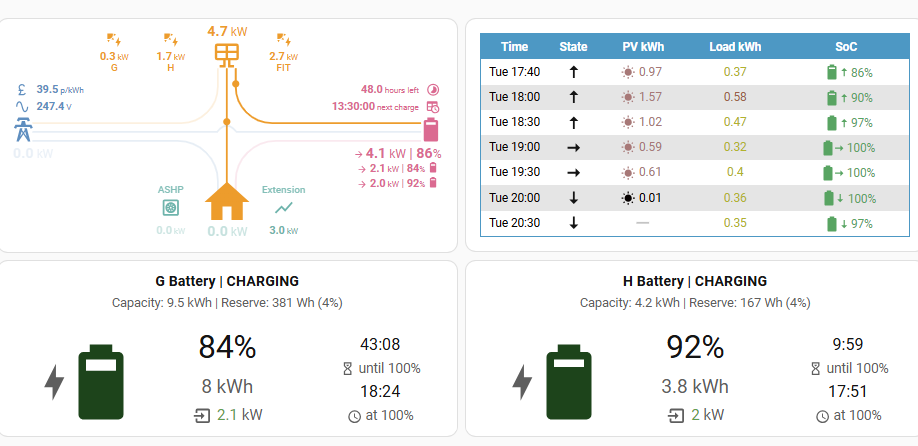
GivEnergy inverter G is producing 0.3kW of solar, H is producing 1.7kW, but my AC coupled FIT array is producing 2.7kW.
Both inverter G and H are charging with some of the FIT AC as well as their own solar, thus preventing it being exported
Thank you for the diagram. How is you AC coupled array connected, is it after the distribution box and wired into the AC input of your inverters via its own DC to AC inverter?
the wiring is complicated, but in essence:
grid supply coming into the house, through the meter, then the meter tails go into a splitter box.
The hybrid inverter CT clamps are on the meter tails before the splitter box so measure everything coming in or out of the house through the meter
One of the cables from the splitter box goes to the hybrid inverters AC input
Another of the cables goes to the house extension
Another to a consumer unit that has the AC coupled (FIT) inverter output connected into it
So entirely analogous to plug in solar going into a ring main. Where it wouldn’t work is if the plug in solar was connected to a ring main is on the EPS output side of the inverter. As long as everything is on the input side and the CT clamp is beforehand it should all work