I’m trying to work out my real savings and part of this is to know the additional grid load (by month say) used by the inverter. I can’t see how I can get or derive that data.
I note that during the night when the battery runs down , the inverter is consuming about 37W off the grid.
Does anyone know how I can get this from GivTCP or the GE Cloud?
The Android App Monitor for GivEnergy Inverter (see elsewhere this forum) does make ‘estimates’ of the power flows. I commend it as a decent overview and use it daily; read the notes for the authors caveats.
I suggest this is as good as it gets as from a limited review and analysis. The power consumed (losses) appear to be a complex function of source of power, load, etc etc.
My personal take is that I am saving some energy (cash) and helping the planet, and even being a data rational engineer, and if I knew all the detail, there is little I can do to change the functioning of the system.
After three years, I work on about 18% loss round trip through the battery and 4% losses in inverter alone. Others may have alternative measures.
Thanks for you input. I’ve got the official GivEnergy app and another (that seems to be labelled “Inverter”). Neither are rock solid so I tend not to use them. GivTCP isn’t either but doesn’t miss too much data so I just use HA to monitor what’s going on now.
I guess I can be a bit obsessive with data and what to know what I am really saving. Sure, when you get all the quotes you get told you’ll be generating so much energy, but none tell you the additional energy that the Inverter/battery consume. I’m not worried if they are consuming solar but I am if it’s coming from the grid. Hence my post here.
Related, I’m trying to pin down exactly what the data coming from the cloud portal means. EG. Looking now (13:30) at today’s figures shows Generation - 9.2kWh, Solar to Grid - 0.1kWh, Solar to Home - 3.6kWh, Solar to Battery - 4.4kWh. These last 3 total 8.1kWh which is 1.1kWh less than Generation! So I’m guessing that Generation is what is coming from the panels being the integral of Current * Voltage and is what has ‘gone into’ the inverter. Further, I’m guessing that Solar to Home is the actual benefit from solar I have got so far today. I’m assuming some Solar is powering the Inverter and some is lost in conversion to AC.
Then there’s the battery. Solar to Battery I assume is what has really gone into the battery so there are some losses in converting PV current/votage to Battery charging current/voltage.
What comes out of the Battery when the sun goes down presumably powers the Inverter now and some gets converted to AC to run the Home. I assume the Battery to Home figure is the real energy that’s gone into the Home (ie the real saving). Inefficiencies dictate that this will be less than what went into the Battery - I accept that.
When the Battery runs out the Inverter must then run off the Grid at a cost (~38W)!
Anyway, you are right about not being able to change anything, I just wanted to get as near the real savings as I could for my own peace of mind and curiosity.
I empathize and sympathize. However I have not used any HA system, so have limited knowledge on its performance and accuracy [currently in the life’s too short category].
I did some work on the tolerances of the measuring system, and as always, it depends… There are an awful lot of bits in the measurement system whose tolerance is around 1% accuracy or so (generally worse). And of course the calculations and sample timing has some effect too. One hopes that across a large system some of the errors will cancel each other out; but there’s always Murphy’s Law and some of us will be towards one extreme or the other.
I have done a quick comparison between GE online reports [sum of monthly and annual] and Octopus [as charged] and allowing for some possible timing (date) issues I see a variance (I cannot say error) of around 2.5% on export and 6% on import - the latter needs more examination in case there is some systemic fault. For clarity: Octopus report greater export and import of energy - the bit I pay for.
BTW: there has been talk of ‘faster response’ firmware (which is not available to my Gen 1 inverter) so the battery responds more quickly to load step changes. I understand the corollary is that the self-consumption is higher to keep the circuitry active and ready. You pays your money etc… Others have received a trial software load and may comment from experience.
On my 5 kW Gen2 hybrid inverter during the night with no solar gen, the Android App reports inverter power of 16 W when the battery is idle. As soon as there is any battery charge/discharge or solar gen the power value increases.
The GE energy graphs are known not to be very accurate as they are based on 5 minute snapshot values.
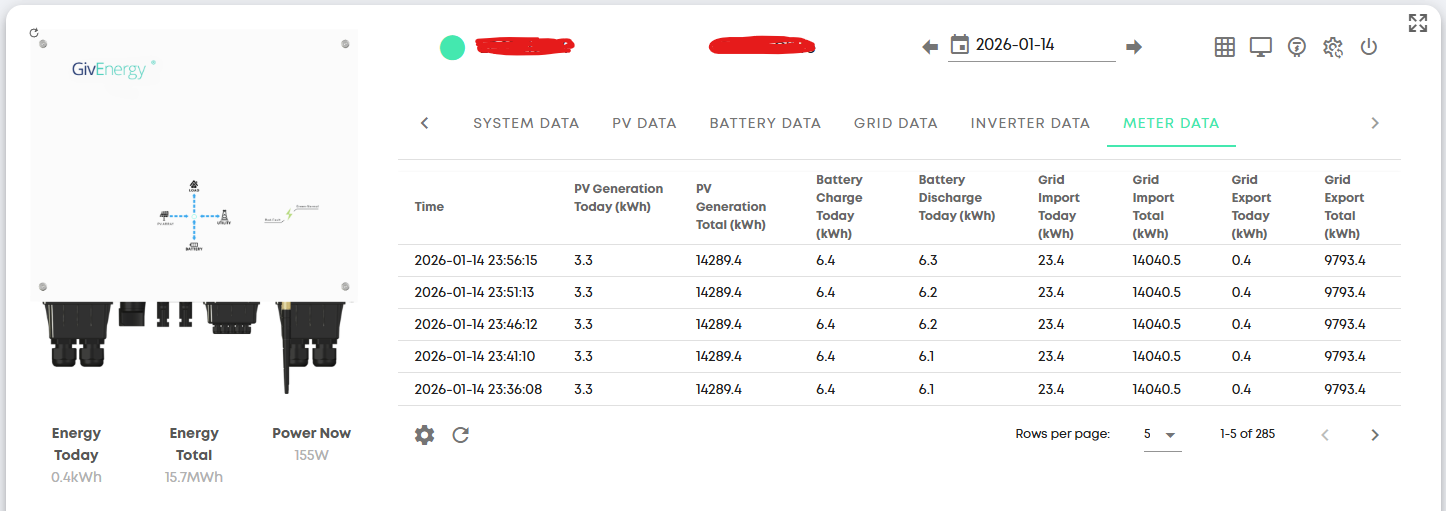
The most accurate data from GE is when using the My Inverter - Meter Data section of the web portal (givenergy.cloud).
I record the last values of each day in a spreadsheet in order to calculate daily, monthly and annual figures.
What is not obvious is how much energy the inverter consumed in the process, though unless you can change the inverter to a more efficient one, the inverter losses are what they are.
Grid charging of the battery may be more efficient at less than the maximum charge rate, but I have not experimented to find out. With my battery being outside I tend to set the charge rate so most of the cheap rate period is used, keeping the battery warmer in Winter.