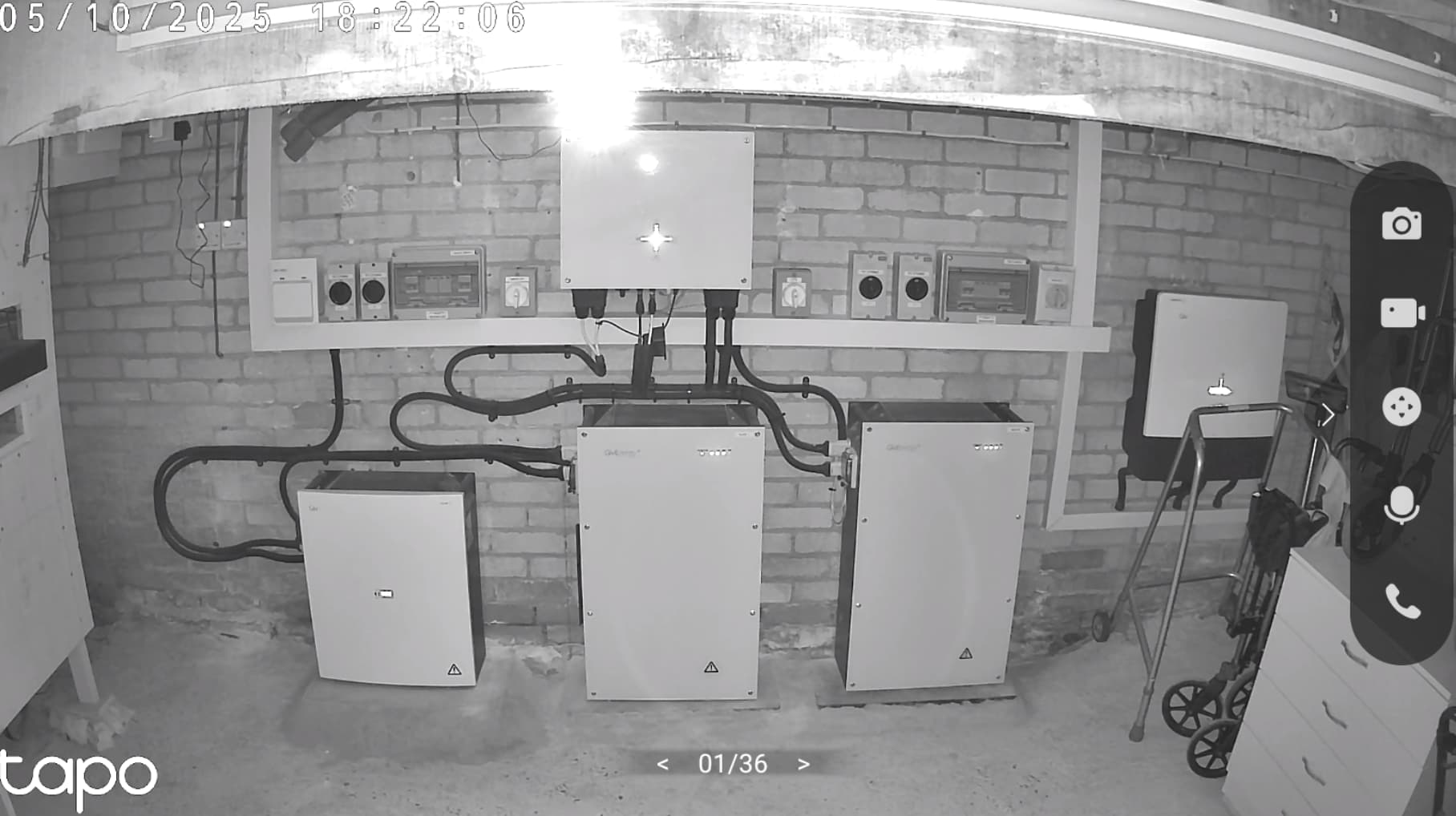
Good morning.
My name is Mark Hudson, and I live in Anglesey.
I currently have 36 Solar panels on both South and West facing roofs.
24 on the South and 12 on the west.
The south facing panels are supplying a “Gen 2” 5 kWh hybrid inverter and the west facing panels supply a “Gen 3” 3.6 kWh string inverter.
There are 2 x “Gen 2” batteries and 1 x “Gen 3” (Both 9.5 kWh) attached to the “Gen 2” Hybrid inverter.
My master plan is to replace the String inverter with a “Gen 3” Hybrid 3.6 kWh and purchase an additional “Gen 3” 9.5 kWh battery.
The original “Gen 3” 9.5 kWh battery (now connected to the “Gen 2” Hybrid) will then be connected with the new “Gen 3” 9.5 kWh battery to the new Hybrid inverter.
So, the 5.0 kWh inverter will now have 2 x 9.5 kWh “Gen 2” batteries, and the new Hybrid will have 2 x “Gen 3” 9.5 kWh batteries.
My question is……
Should I install 1 x EM115 to each inverter and place them on the incoming tail and connect the 2 inverters with a Cat 5 data cable or is there an alternative method?
Your help and inspiration will be greatly appreciated.
I look forward to hearing from you.
Kind regards.
Mark.
this sounds very much an installer question so maybe you need to contact givenergy directly for their advice
but…
I have two gen 1 hybrid inverters each with their own battery so I’ll give you my experience of the setup….
Each inverter has its own EM115 and they operate in parallel and independently of each other. A multi-hybrid inverter isn’t a recommended solution for GivEnergy but it does work.
Things you will find out though:
- the two inverters share house load and will both discharge when required to meet that load
- the energy graphs in the portal and the app will be screwed up and meaningless. I get negative consumption for example! Nothing you can do about this without using something like Home Assistant to create your own graphs
- if you have “fast response” firmware (with Gen 2 you probably do), the inverters operate in AC and hybrid mode, so if one inverter battery is full the other can charge from the AC you would otherwise export
- at night time when there’s no solar the inverters will almost certainly cross charge from one to another. For me it’s fairly gentle and it’s 99% of the time from inverter 1 to inverter 2. With newer (faster) inverters like the gen 2 and gen 3 the cross charge will be more aggressive. There are ways round this (e.g. setting one inverter to always discharge at a base rate) but this looses flexibility of the system
There is supposedly an EMS coming that will sit in front of both inverters and control them. At the moment this is only for AC coupled inverters, hybrid is coming at some point. This is of course additional cost and I have heard that the EMS isn’t as fast to respond to changing load as a standalone inverter(s)
Thanks Geoffrey.
What a brilliant and detailed response.
I will have to hunker down and learn Home Assistant by the sound of what you say.
I have plenty of spare computing power so that will not be an issue.
Also I do not export (only by accident) as the property uses on average +/- 90kWh per day.
There are 4 x 300 litre hot water cylinders to keep topped up and an EV to feed so there is not a lot to go back to the grid (not that I can be bothered for £0.15 per unit).
The new equipment should arrive this week and it should be a straight swap for the new hybrid when the string inverter is removed.
I will let you know how it goes.
Thanks again for your valued advice.
Kind regards.
Mark.
1 Like
No problem. Sounds like a big setup you have, 3 batteries, all that solar, and 4 hot water cylinders. I thought my own installation with 44 panels was big. Our heat pump can chew through 90kWh on a really cold day in winter, but fortunately its not too often that happens.
Yes Home Assistant is great, will give you a lot of extra control over your inverters and system than you get with the givenergy app and portal. I’ve been running it for 2 years now, initially to give me proper graphs of consumption, but then battery automation via the brilliant predbat system that optimises my charging and discharging to minimise my spend.
Good luck !