Whole system has stopped working

Found both my batteries switched off in early march they switched themselves off after switching back on a few times over a couple of days they stayed on and the red fault light cleared system was working for around a week or so but the SOC was not looking correct. I then found the battery com cable had disconnected so I connected this back up sure that this would fix the problem but it didn’t.

A few days later the solar stopped working aswell, I have reset it and powered all off and on again checked all the connections but still just taking off the grid and batteries have switched them selves off again and won’t stay on I am at a total loss no email and no phone contact as giv energy now gone bust whilst I have had this.issie.

I tried updating the firmware multiple times for the battery but it fails everytime. In the cloud the battery switches from lead acid to lithium so suggests still a com issue but connection is good. Anyone else have this problem or can help to fix please? Not been working properly for 6 weeks now

Is your installer still in business? Your installer has to provide a level of support for issues.

1 Like

Do you use this app, and if so is there anything recorded in the fault log?

1 Like

They don’t want to know unless I pay them loads to visit.

I don’t use this no but I will set it up and have a look thankyou.

The installer has a responsibility to repair or replace the system if it’s not working

That might mean replacing with a different system of equivalent spec.

If they refuse to help you, go to your credit card provider if you paid that way, possibly debit card provider if that way (less protection on that) or take the installer to the small claims court.

2 Likes

They said it’s out of their 2 year warranty :(

This is from chatGPT but based on my previous knowledge of such stuff it does sound about right

(I assumed none of the system was purchased by credit or debit card, but if part of it was, especially by credit card, then there are other avenues to explore).

In the UK if you buy a solar inverter and battery for your home and the company that manufactured the system goes into administration and the administrator says the warranties can’t be honoured, what protection do you have from the installer (who you paid to purchase and install the system). The installer says they only offer a two year warranty. The manufacturer warranty was 6 years. It wasn’t paid for on credit card or debit card.

In the UK, your rights don’t just depend on the manufacturer’s warranty — in many cases, your strongest protection is actually against the installer (the seller) under consumer law.

Here’s how it breaks down:

  1. Your contract is with the installer — not the manufacturer
    Under the Consumer Rights Act 2015, the business that sold and installed the system is legally responsible for ensuring the goods are:

Of satisfactory quality

Fit for purpose

As described

That responsibility exists regardless of any manufacturer warranty.

:backhand_index_pointing_right: So even if the manufacturer has gone bust and won’t honour the 6-year warranty, that doesn’t automatically let the installer off the hook.

  1. The installer’s “2-year warranty” doesn’t override your legal rights
    A company can offer a shorter warranty, but they cannot reduce your statutory rights.

In England and Wales, you generally have up to 6 years to bring a claim (5 in Scotland) for faulty goods.

So if your inverter or battery fails earlier than a reasonable person would expect, you may still have a valid claim — even after 2 years.

  1. What matters: “reasonable lifespan”
    For something like:

a solar inverter

a home battery system

…it’s reasonable to expect significantly more than 2 years of life. Often 5–10+ years is typical.

If it fails prematurely, you could argue it wasn’t of satisfactory quality at the time of sale.

  1. Burden of proof (important detail)
    First 6 months: presumed faulty at purchase unless installer proves otherwise

After 6 months: you may need to show the fault was inherent (e.g. design flaw, poor quality)

This might involve:

an engineer’s report

evidence of common faults in that model

  1. Remedies you can pursue
    Under the law, you can ask the installer for:

Repair or replacement (first step)

If that’s impossible or disproportionate → partial refund

The refund may be reduced to reflect usage over time.

  1. Manufacturer warranty still matters (sometimes)
    Even though it’s separate from your legal rights, if the installer sold the system highlighting a 6-year warranty, that could strengthen your case that the product should last that long.

  2. What you don’t have (based on what you said)
    No Section 75 Consumer Credit Act 1974 protection (since not paid by credit card)

Debit card chargeback might have been an option, but usually only within a limited timeframe

  1. Practical next steps
    You could:

Write formally to the installer

Reference the Consumer Rights Act 2015

State the system has not lasted a reasonable time

Request repair/replacement or partial refund

If they refuse:

Use Alternative Dispute Resolution (ADR) if they’re part of a scheme

Or escalate to small claims court

Bottom line
The installer saying “we only offer a 2-year warranty” is not the end of the story. If the system has failed earlier than a reasonable lifespan, you may still have a valid claim against them under UK law — even without a manufacturer warranty or credit card protection.
2 Likes

Thank you for this. I have an issue though in that the original install was done by Dorset Electrical Solutions that was panels invert and battery but a year later I got another battery installed by another installer TPH. So not sure where I stand now, I believe the guy from TPH is going to visit soon however he has mentioned out of 2 year warranty also but it’s not and I’ve proved that to him so maybe I should wait and see what happens after his visit? I am disappointed with DES’s attitude though and they have ignored my last email.

the way givenergy treated the install is that it was the last installer that touched the system was responsible for the whole of the install

but the consumer credit act would be based upon who supplied and fitted the kit. It sounds like an inverter problem so you need to pursue your original installer

obviously if the battery installer can help, and even if it costs you for a call out charge, that might be a better and quicker solution

2 Likes

I’m guessing both batteries became flat? Thus would need jump starting?

A bit harsh on the new installer to get them to sort both batteries and the inverter.

I guess some kind of compromise might be needed (e.g. new installer charges for time and materials for the things that they’re not legally responsible for).

But strictly speaking, would have to claim against the original installer for most of the work and the new installer for the other battery (the newer one).

1 Like

I just purchased this app and tried resetting the inverter, I switched my batteries back on but they are not being seen by the inverter it’s showing no connection. I tried restarting the inverter but it came up corruption in the history meaning * Corruption - A control other than the intended one changed!

Thank you for the support, but I didn’t mean for you to purchase anything. More that if you had the app before the system failed, the fault log might have recorded the faults as they happened. If the app doesn’t help you, you can get a refund from Google.

If it says no connection, that typically means the IP address is wrong (or the system is off!). If you get the app connected, the main screen might give you some clues. Check grid status and voltage, same with battery.

2 Likes

Ah is it your app? It’s very good. It’s giving me info that might help lol the corruption status. It’s connected I can see the grid demand and it tallies pretty much with the the giv energy app. I synced the time a few times as it was out by over a minute. The app is telling me ther e is no battery connection which makes sense and there is solar voltage on 2 banks but it’s not registering as an input on the home screen and it’s not being used or exported so I don’t know where all this light energy has been going for the last 6 weeks :( do you think it’s worth resetting the dongle? Even though it’s connected albeit maybe not fully hence the comm issues with the restart etc?

no, resetting the dongle means that your dongle will have to be reprogrammed to connect to your inverter which in of itself will put you further away from having a working system

whatever issues you have is nothing to do with the dongle. The dongle only sends inverter information to the givenergy cloud or any other connected local apps, its not involved in translating/condensing the data at all

1 Like

DO NOT RESET THE DONGLE. The dongle is working. Leave it alone.

1 Like

If your battery has not received any charge for six weeks, and you didn’t take any action to turn it off, then it will probably be empty and you will need someone to come out and fix it.

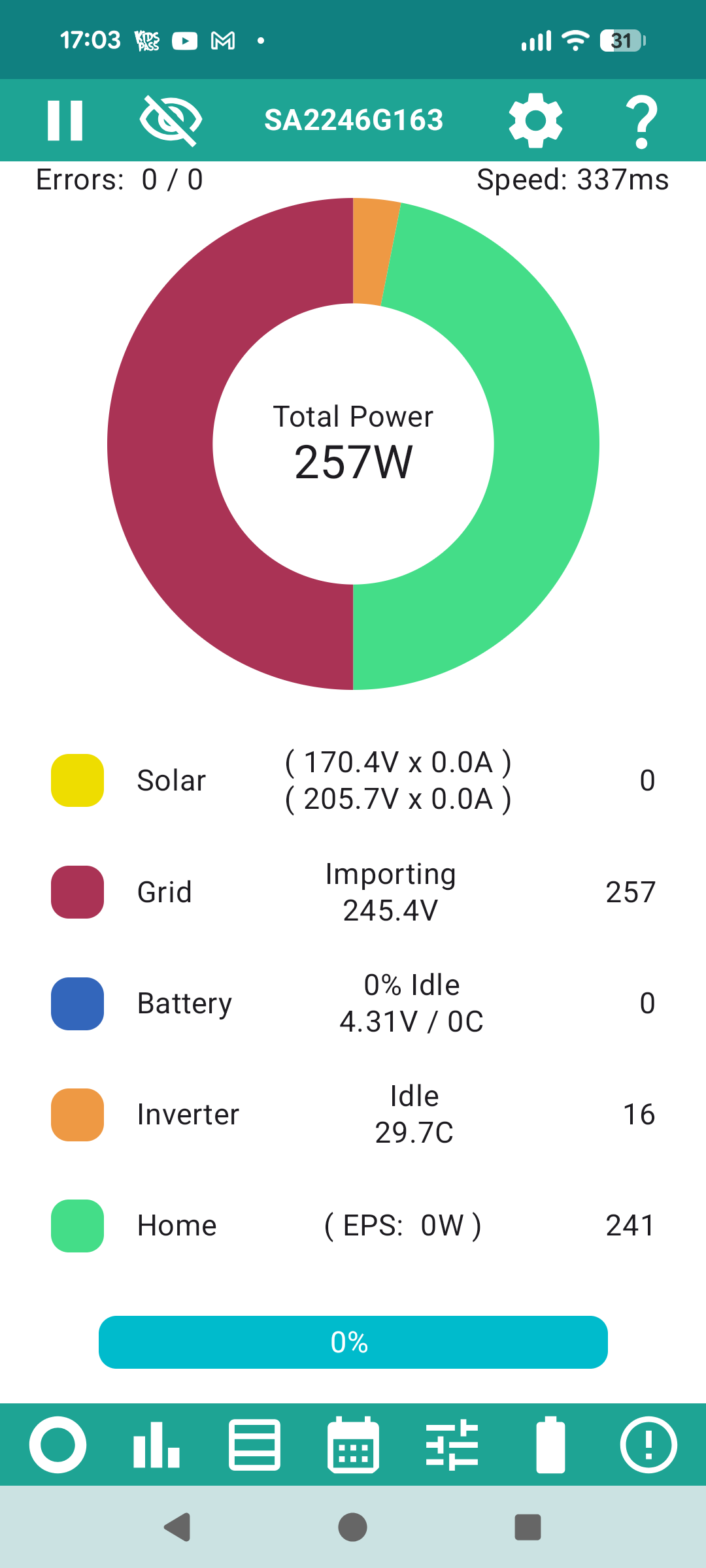
For my app, on the Grid line, does it say importing, exporting, balanced or outage? And does the voltage look reasonable? i.e. between 220V and 250V.

Batteries switched them selves off and continue to do after a few mins. Does this look ok?

Do you hear a load of clicking just before the batteries turn themselves off?

If so, can you turn off the DC breaker between the batteries and the inverter then try turning the batteries on, one at a time, again.

If the batteries stay on, without a load of clicking sounds, then there’s a problem with the inverter (battery board on the inverter).

If the batteries still turn off, then it’s a battery issue (could be very low charge per above)

If there isn’t a load of clicking noises at all, then it’s probably just low battery charge and/or the Comms lead is loose (assume you’ve checked both ends of the lead!)

Can’t hear any clicking but If it’s a battery issue though why has the inverter stopped using the solar?

1 Like